Sorry I haven't posted for a while. I've been working on the YFZ Ranch/FLDS story. Which brings me to a new post-- court cases. They can be difficult especially since in local tv, you don't generally get to cover the whole trial, just the opening, closing and verdict. It's really hard to be parachuted in to cover the end of the trial and be expected to get everything when it's the first time you've stepped foot in the courtroom.
Here are some suggestions:
If at all possible, have the same reporter do beginning and end of trial. Let them be in the court as much as they can so they can know the players and chat them up. Sometimes the media is sent into an overflow room-- which is fine, you can still hear testimony, except that I you won't be able to recognize all the main people and develop a rapport with them.
If you can't keep your reporter in the court through the whole trial (and most can't) at least try to have a body in the court. Have an intern who's gathering dust at the desk? Send them and have them make contact with people (daily) and monitor developements. Later, they can hang with the photographer to show them who's who on entries and exits. After the verdict, they can also grab interviews for you.
Having the same photog covering the trial throughout can also be helpful-- for the same reason that they'll know who the players are.
Make friends with the folks in the judge's office. Put requests in early to talk with jurors. Make sure you have a couple names on any contact lists they may have.
Maggie L
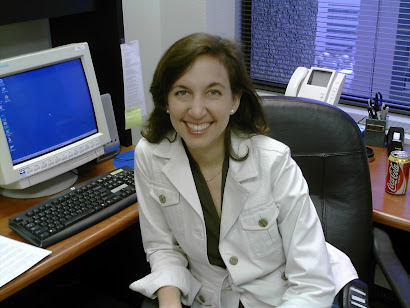
One of the rare times I'm in the office
Tuesday, April 22, 2008


Thursday, April 10, 2008
Morning Show Tips
Brilliant t.v. guy I know did a column on morning shows for tvspy.com.
Check it out...
http://www.tvspy.com/shoptalk.cfm?page=1#drew
Check it out...
http://www.tvspy.com/shoptalk.cfm?page=1#drew
Tuesday, April 8, 2008
Special Events Planning Part 2
There is no set plan for special events. What you do depends on the event. A lot of you will probably have elections stuff coming up. It's never too soon to start planning. Even if it's just talking to people to get a better sense of what kind of time line you'll actually need to get things done. I am a huge fan of "back-timing your life," so once you get a list of all the things you need to get done, arrange it in a manner where the deadline is the event. It's almost like you might plan a party as my cheesy time line below illustrates...
Wed: Pickup Balloons
Thur: Decorate
Fri: Pick up enchiladas from Rosa's Cantina.
Sat/9a: Clean
11a: Put enchiladas in oven
1130a: Set flowers and food out
Noon: Guests arrive
Point being, if you have a master list, you don't have to worry about forgetting things.
At the earliest stages of your planning, talk to EVERYONE you can think of. Find a producer or EP who has planned the event before or done something similar. Call a friend in a different market who may have had experience with it.
Site survey early! Bring a trusted photog who has done this type of event before and have them walk through the location with you. I think the best way to do things is not to go in with too many preconceived ideas about how the coverage will take place. Have a few ideas and throw it out to the people who will actually make it happen- "This is what I would like to accomplish, how can we make that happen?" That leaves it open-ended and asks people for their creative input. So, for example, I produced a live consumer show from a woman's house. I told the photographer, "I'd like a different look each time we come to our anchor." I didn't specify locations or rooms, I just let him take it from there. Same with graphics. "I'd like something that animates and has this kind of feel." Let the graphics person amaze you. But check in early and often to make sure you're on the same page.
Another key element of site survey is -- Where are we going to put the truck or trucks? Send your trucks out in advance to make sure you can get a signal or reach the satellite. Is it on a busy street? Is parking limited? Are there tall buildings around? Will the truck need to park the night before? VERY IMPORTANT: Will I need special permits to park here? Permits that need to be filed in triplicate three weeks in advance? If there is a police presence, make best friends with the officer coordinating.
With elections, call campaigns early and often about their plans and don't forget to contact the Board of Elections people as well.
Wed: Pickup Balloons
Thur: Decorate
Fri: Pick up enchiladas from Rosa's Cantina.
Sat/9a: Clean
11a: Put enchiladas in oven
1130a: Set flowers and food out
Noon: Guests arrive
Point being, if you have a master list, you don't have to worry about forgetting things.
At the earliest stages of your planning, talk to EVERYONE you can think of. Find a producer or EP who has planned the event before or done something similar. Call a friend in a different market who may have had experience with it.
Site survey early! Bring a trusted photog who has done this type of event before and have them walk through the location with you. I think the best way to do things is not to go in with too many preconceived ideas about how the coverage will take place. Have a few ideas and throw it out to the people who will actually make it happen- "This is what I would like to accomplish, how can we make that happen?" That leaves it open-ended and asks people for their creative input. So, for example, I produced a live consumer show from a woman's house. I told the photographer, "I'd like a different look each time we come to our anchor." I didn't specify locations or rooms, I just let him take it from there. Same with graphics. "I'd like something that animates and has this kind of feel." Let the graphics person amaze you. But check in early and often to make sure you're on the same page.
Another key element of site survey is -- Where are we going to put the truck or trucks? Send your trucks out in advance to make sure you can get a signal or reach the satellite. Is it on a busy street? Is parking limited? Are there tall buildings around? Will the truck need to park the night before? VERY IMPORTANT: Will I need special permits to park here? Permits that need to be filed in triplicate three weeks in advance? If there is a police presence, make best friends with the officer coordinating.
With elections, call campaigns early and often about their plans and don't forget to contact the Board of Elections people as well.
Note to Photogs Re: Murphy's Law
When setting up live shots and deciding whether or not to cable across train tracks, consider that the fine police officers who told you, "Oh no, another train won't be coming through for days," might, in fact, be clueless (or malicious) and leave you scrambling to retrieve a dozen or so cables in two minutes or so you have as an impending train approaches.
Note to Self Re: Hotels
When coming to a city for an assignment and one is not sure how long said assignment is going to last, it might make some sense to book the crew's hotel for say, a whole week. The rooms can, after all, be cancelled. If perhaps, one only books for a two days and then forgets to extend-- and the rest of the goofball press arrives and grabs every available room within a 50 mile radius, the crew might find themselves at the Bates Motel with sagging beds and a "massager" that takes quarters. I am exaggerating only slightly.
Tuesday, April 1, 2008
Small Market Slammin'
I was in a small market newsroom the other day and it reminded me that not every producer has a huge cadre of writers. Or any writers, for that matter. With that in mind, here's some advice for cranking out a show solo.
When you are writing the whole show, you must write really fast. There is no time for dawdling over scripts. Just get a version out and then edit it. I only started paying attention to how fast I wrote after a bad experience when I was a young writer. A producer took a script I was working on and gave it to ANOTHER writer because he thought I'd been working on it too long. I assure you that never happened again-- because from that day forward, I started timing myself on how long it took me to write each script. I gave myself ten minutes for vos, 15 for vosots, etc.
Start writing from the bottom of your show.
Do the things you are least likely to change FIRST. For me, that meant writing the kicker first, then stories around weather and sports and b-block tease-ables. With the rest of the show out of the way, then you can focus your attention on the first block and the stories that are likely to change.
Try to do the easiest stories first.
Nothing gives you a feeling of satisfaction like cranking out a ton of stories. Read everything you can all day and listen to and watch every radio and tv newscast you can. This will make it easier when you sit down to write and also help catch little mistakes when you proofread. Were there three cars in that accident or four? If you've been listening to it all day, you're less likely to miss the mistake. Having all that info in your head also makes it infinitely easier to write a story than if you're just seeing and learning about it.
After finishing the easiest and least changable stories, then you can slow down a little and focus on some items that might take more of your time. Do this in managable chunks, So, for example, I might take my national or international wires back and look at the video for each of them and then come back and crank through those stories. Then I might take my local vos back to editing and look at and write those. Then vosots. And so on. You get the idea. With many newsrooms going tapeless and video delivered to your desktops, writing becomes even easier.
If your anchors write, that's awesome. It might make some sense to let them chose what they'd like to write. Another option is saving them for one big project, like the national story you want to package as a lead or local reporter piece you want to redo into a mini-pkg. Better yet, have reporters who turned the story leave a version for you, even if it's a vo.
NEVER hand off opens and teases. Those are yours and they are some of the most important parts of the show.
The best part of being able to write a show all by yourself is that when you get to a market where there ARE writers, you feel like you've been dropped onto another planet called "the lap of luxury." You may even catch yourself saying something stupid like, "It's just easier for me to write it than to have to read someone else's scripts and change them."
When you are writing the whole show, you must write really fast. There is no time for dawdling over scripts. Just get a version out and then edit it. I only started paying attention to how fast I wrote after a bad experience when I was a young writer. A producer took a script I was working on and gave it to ANOTHER writer because he thought I'd been working on it too long. I assure you that never happened again-- because from that day forward, I started timing myself on how long it took me to write each script. I gave myself ten minutes for vos, 15 for vosots, etc.
Start writing from the bottom of your show.
Do the things you are least likely to change FIRST. For me, that meant writing the kicker first, then stories around weather and sports and b-block tease-ables. With the rest of the show out of the way, then you can focus your attention on the first block and the stories that are likely to change.
Try to do the easiest stories first.
Nothing gives you a feeling of satisfaction like cranking out a ton of stories. Read everything you can all day and listen to and watch every radio and tv newscast you can. This will make it easier when you sit down to write and also help catch little mistakes when you proofread. Were there three cars in that accident or four? If you've been listening to it all day, you're less likely to miss the mistake. Having all that info in your head also makes it infinitely easier to write a story than if you're just seeing and learning about it.
After finishing the easiest and least changable stories, then you can slow down a little and focus on some items that might take more of your time. Do this in managable chunks, So, for example, I might take my national or international wires back and look at the video for each of them and then come back and crank through those stories. Then I might take my local vos back to editing and look at and write those. Then vosots. And so on. You get the idea. With many newsrooms going tapeless and video delivered to your desktops, writing becomes even easier.
If your anchors write, that's awesome. It might make some sense to let them chose what they'd like to write. Another option is saving them for one big project, like the national story you want to package as a lead or local reporter piece you want to redo into a mini-pkg. Better yet, have reporters who turned the story leave a version for you, even if it's a vo.
NEVER hand off opens and teases. Those are yours and they are some of the most important parts of the show.
The best part of being able to write a show all by yourself is that when you get to a market where there ARE writers, you feel like you've been dropped onto another planet called "the lap of luxury." You may even catch yourself saying something stupid like, "It's just easier for me to write it than to have to read someone else's scripts and change them."
Careful with Video
Be careful using file video for current and possibily litigation inspiring stories. For example, when talking about several baggage handlers caught stealing from luggage, best not to show file video of random luggage handlers. Same goes for any file video where the people in the file might be mistaken for the criminals in your story.
Subscribe to:
Comments (Atom)

